Logic and emotion
The HumansLogic and emotion is the conflict between the Alien narrator’s faith in a civilization ordered by pure reason and the feelings he encounters on Earth. What begins as a contrast between rational immortality and human vulnerability becomes a crisis within his own identity: the narrator can explain care as strategy, but increasingly experiences it as a need. The concept binds his account of Vonnadorian society to his changing responses to pain, attachment, and the lives he has been sent to assess.
Reason as a civilizational ideal
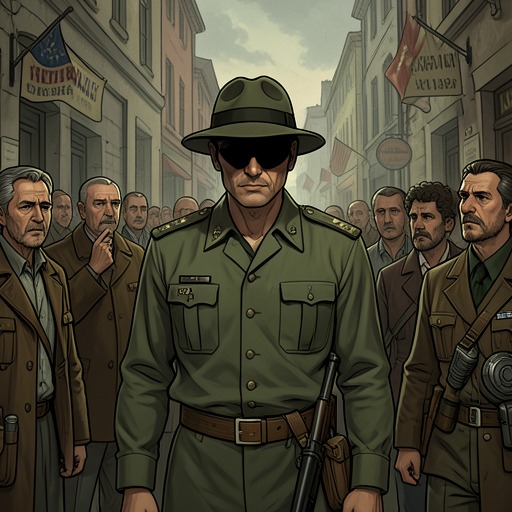
The narrator describes his home as a place without love or hate, passion or remorse. Actions there have logical motives and produce the best available outcome; because passion is absent, there are no crimes of passion. This is not presented simply as individual self-control. It is a social order in which the requirements of the collective take precedence over personal desire, and where the inhabitants have never been at war with themselves.
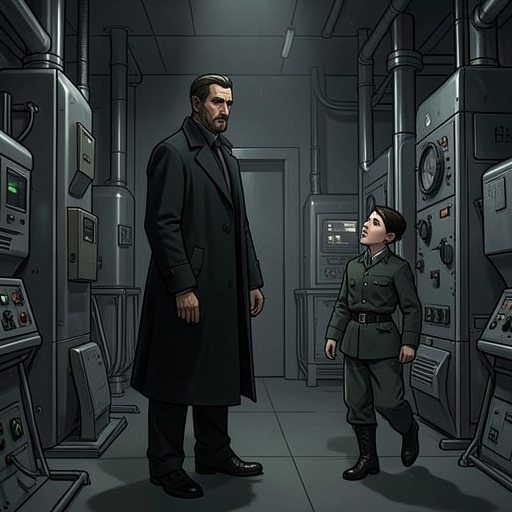
That internal harmony supports extraordinary technological power. Comprehensive mathematical knowledge enables the Vonnadorians to travel great distances and rearrange, renew, and replenish their biological components. They are, the narrator insists, psychologically equipped for these advances. Their solution to fear is to solve death: they do not die, and so cannot leave the universe to unfold without interference when they will remain within it for eternity. In this account, reason is both a method of knowledge and a guarantee that power will be used in the collective interest.
The same reasoning turns Daniel Russell’s death into a defensible calculation. The narrator argues that if human mathematical advancement exceeds human psychological maturity, intervention is necessary; Daniel’s death and the knowledge he possessed might save many more lives. He can therefore call Daniel a logical and justifiable sacrifice. The formulation shows how completely the Vonnadorian ideal converts a particular death into an outcome to be evaluated, while leaving little room for grief or remorse as reasons to question the calculation.
Earth as a challenge to the category of the human
The narrator’s mission is not only to destroy information but also to gather knowledge about how Humans live. He rejects the judgment that they are merely shallow mysteries: they exist, he says, at once in a world of appearances and a world of truth, joined by connections that take many forms. This claim changes the problem from one of collecting facts to one of learning how meanings attach to ordinary things.
His examples are deliberately everyday. He initially cannot understand why clothes matter, how a dead cow becomes beef, why a lawn cut in a particular way should not be walked upon, or why household pets matter so much. He interprets these customs as signs of human anxiety about nature and reassurance in the belief that it has been mastered. Lawns, the transformation of wolves into dogs, and architecture built around unnatural shapes all become evidence in his attempt to read human life. Yet his account also unsettles the division between human beings and nature: nature, he concludes, is a symbol of human nature, and the two are interchangeable. The seemingly trivial details he must learn are therefore not distractions from his investigation but clues to the human meanings his rational framework cannot initially see.
Care becomes more than a tactic
Newton first appears to the narrator as a possible source of useful information. The dog growls at him, shows his teeth, and recognizes that something is wrong, although the narrator does not yet understand his language. The narrator also sees that Newton’s years of subservience to bipedal owners lend authority to an upright figure. Reading the encounter strategically, he reasons that relieving another’s pain is a reliable way to gain support.
He gives Newton a biscuit, then restores his sight and heals him while stroking his hind leg. The act costs the narrator: he develops a more intense headache and waves of fatigue, and falls asleep on the kitchen floor. On waking, he is coated in dog saliva as Newton enthusiastically licks him. The narrator asks the dog to stop, but Newton is physically incapable of doing so until the narrator stands. The scene begins in calculation, but its bodily aftermath is not reducible to information-gathering. The narrator recognizes that alongside an urge to hurt, he has begun to feel an urge to heal—and admits that his earlier logic now seems ridiculous.
Pain, attachment, and a divided self
The conflict becomes personal when the narrator considers his wounds and the care a human woman has given him. He knows he is not the person whose identity he occupies, yet also feels that he is losing himself. Her beauty is nearly appreciable to him; her unusual skin fascinates him, and her care matters. Against the Vonnadorian conviction that technology can care for its inhabitants and that they need no emotions or anyone else, this particular human attention creates a contradiction he cannot dismiss.
The narrator is afraid to fall asleep because his wounds will heal, yet in that moment he does not want them to. He finds real comfort in the pain. Physical suffering, which a system organized around renewal might treat only as something to eliminate, has become bound up with his experience of being cared for and with a self he can no longer define through reason alone. His uncertainty is not resolved into a new doctrine: it remains a set of worries and questions.
Logic and emotion thus describes both a civilizational contrast and an inward change. The narrator’s Vonnadorian reasoning can justify Daniel Russell’s death, explain the utility of helping Newton, and classify human customs as objects of study. It cannot fully contain the experiences those explanations encounter: a dog’s dependence, a woman’s care, or the narrator’s attachment to pain. The tension does not make reason disappear; it reveals that reason alone cannot account for what the narrator is becoming.